Children are naturally curious. They ask why the sky changes color, wonder how machines work, build elaborate structures out of blocks, and experiment with what happens when they put their ideas into action. STEM enrichment gives that curiosity somewhere meaningful to go.Through science, technology, engineering, and mathematics, children can explore questions, test ideas, solve problems, and learn from the results. The goal is not simply to introduce more academic material. A strong STEM enrichment program for kids creates opportunities to think independently, work through challenges, and become more comfortable tackling something unfamiliar. Over time, those experiences can help turn "I wonder what happens if..." into "I think I can figure this out."
STEM Enrichment Gives Curiosity a Purpose
Curiosity is often where meaningful learning begins. When children genuinely want to know how something works, learning becomes more than completing an assignment. STEM activities give children opportunities to investigate those questions for themselves and become active participants in the learning process.A science experiment might encourage a child to make a prediction and observe what happens, while a coding project can challenge them to determine why a program is not behaving as expected. Building a robot or working with electronics may require them to test different approaches until they find one that works. Instead of always being given an answer, children have opportunities to participate in finding it, helping them practice asking questions, making connections, and investigating possibilities.
Problem-Solving Becomes Something Kids Practice
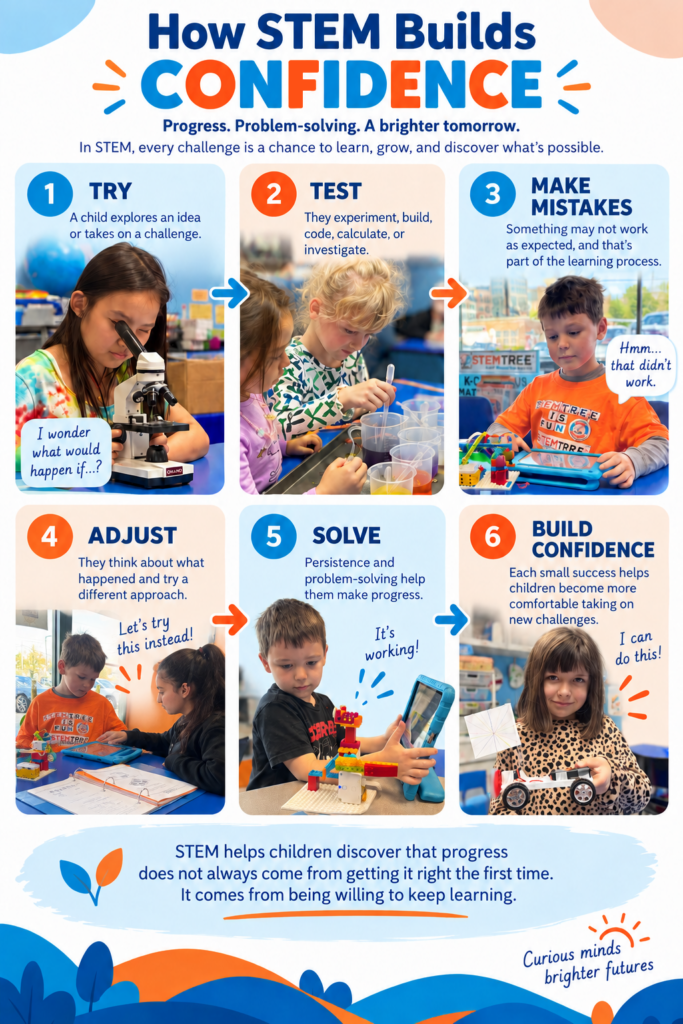
Children encounter problems every day, both in and outside the classroom. STEM provides a structured environment where they can practice working through those problems instead of expecting every answer to come immediately.Imagine a child programming an animation that does not move the way they intended. They have to look at what they created, identify what might be wrong, make an adjustment, and test it again. Similarly, an engineering activity where a structure keeps falling might require the child to reconsider the design, change the materials, or try a completely different approach.These experiences reinforce an important lesson: getting the answer wrong the first time does not mean the learning has stopped. Testing, adjusting, and trying again are all part of solving a problem. As children encounter this process repeatedly, challenging tasks can begin to feel less intimidating, and they can become more willing to investigate what they might try next.
Hands-On Learning Makes Abstract Ideas More Concrete
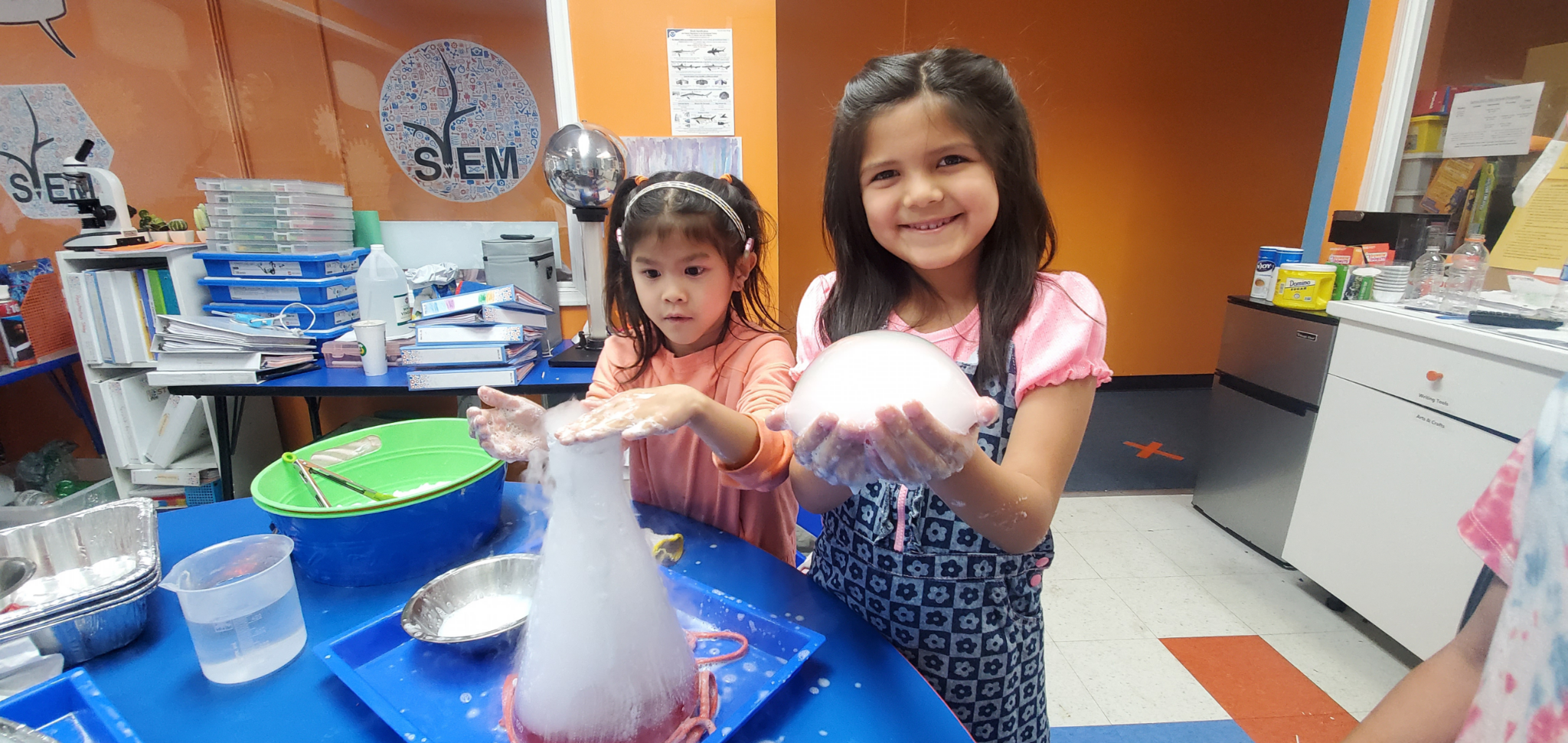
Some STEM concepts can feel abstract when children encounter them only through textbooks, worksheets, or lectures. Hands-on experiences give those ideas context by allowing children to interact with what they are learning and observe how concepts work in practice.Ideas involving electricity, motion, measurement, programming, engineering, and scientific investigation can become easier to explore when children can manipulate materials, observe cause and effect, and apply what they have learned. These experiences can complement classroom learning by giving children another way to engage with important concepts.For families looking for ongoing opportunities to build on school-day learning, aregular STEM program can provide structured time to review, learn, and apply STEM concepts. Stemtree's regular program serves K-12 students through science, technology, engineering, and mathematics activities, with learning experiences designed around students' knowledge and skill levels.
Kids Learn That Mistakes Are Useful Information
Confidence does not require children to always get things right. STEM activities can help children understand that an unexpected result is often an opportunity to investigate what happened and determine what they can do differently.Experiments do not always produce the expected result, code does not always run correctly, and robots do not always move as planned. A mathematical strategy may also lead to the wrong answer. In each case, children have an opportunity to examine what happened, reconsider their assumptions, and make changes based on what they discovered.Over time, this process can help children develop persistence and become more comfortable with challenges. Instead of viewing a mistake as the end of an activity, they can learn to treat it as useful information that helps guide their next attempt. That way of thinking can be valuable well beyond a single STEM project.
STEM Can Encourage More Independent Thinking
As children develop their STEM skills, they also have opportunities to make more decisions for themselves. They may need to decide what to test first, which approach makes the most sense, why something happened, or what they could change to produce a different result.Questions like these require more than memorization. They encourage children to analyze information and make decisions based on what they already know. A supportive STEM environment can provide enough guidance to help children continue progressing without taking the thinking away from them.For parents, this is an important quality to consider when evaluating enrichment opportunities. Strong learning experiences do more than keep children occupied after school. They create meaningful opportunities for children to think, create, investigate, and apply what they are learning.
After-School STEM Can Turn Free Time Into Exploration
The hours after school can provide children with another opportunity to explore subjects they find interesting without simply extending the traditional school day. A thoughtfully designedafter-school STEM program can introduce or reinforce important concepts in an environment that encourages exploration, problem-solving, and creativity.This can be especially helpful for children who become more interested in a subject once they have the opportunity to interact with it differently. A child who finds science difficult in the classroom may respond differently when conducting an experiment, while a child who enjoys video games might discover an interest in coding after learning how digital projects are created. Another child may become fascinated by engineering after building and testing something themselves.Giving children different ways to interact with STEM can help them discover interests they may not have encountered otherwise. Those discoveries can encourage them to keep asking questions and pursuing topics that capture their attention.
Confidence Grows Through Progress, Not Pressure
One of the most meaningful outcomes of STEM enrichment can be the moment a child realizes that they solved something that once seemed difficult. Maybe they finally fix a coding problem that had frustrated them, get a circuit working after several attempts, or understand a math concept that previously seemed confusing.The achievement matters, but so does everything that happened before it. The child asked questions, experimented, made mistakes, adjusted their approach, and eventually made progress. Confidence built this way is grounded in experience because children begin to see evidence that they can learn difficult things when they have the opportunity, support, and persistence to work through them.This is also why the learning environment matters. Children enter STEM programs with different interests, experiences, and levels of understanding. Giving them appropriate challenges and room to progress can make learning more meaningful than expecting every child to follow exactly the same path.
STEM Skills Connect to the World Beyond the Classroom
Science, technology, engineering, and mathematics are not isolated school subjects. They influence how people communicate, build, create, analyze information, solve everyday problems, and understand the world around them. STEM enrichment can help children begin making those connections at an early age.Coding demonstrates how instructions and logic create digital experiences, while robotics combines programming with engineering. Electronics can make concepts involving circuits, electricity, light, sound, and magnetism tangible. Science encourages investigation, and mathematics provides tools for identifying patterns and solving problems.The objective does not have to be preparing every child for a STEM career. Instead, enrichment can help children develop useful ways of thinking while giving them opportunities to discover what genuinely interests them. That educational mission can extend into communities as well, which is part of the opportunity behind bringing aSTEM education franchise to more families.
What Parents Should Look for in STEM Enrichment
Not every activity labeled "STEM" provides the same learning experience. When considering a program, parents can look beyond the list of subjects offered and think about how children actually learn during each session.A strong STEM enrichment experience should give children opportunities to participate actively rather than simply watch. Activities should encourage them to ask questions, solve problems, and understand the ideas behind what they are doing. It is also worth considering whether instruction can respond to a child's current knowledge and abilities, since a challenge that is too easy may not encourage growth while one that is too difficult can become frustrating without appropriate support.Most importantly, children should have room to be curious and participate meaningfully in their own learning. When that curiosity is supported with opportunities to investigate, experiment, and solve problems, children can gradually develop greater confidence in what they are capable of learning.
Helping Curiosity Grow Into Confidence
A child's question about how something works may seem small, but questions are often the beginning of discovery. With opportunities to experiment, create, solve problems, and learn through experience, children can develop more than knowledge of science, coding, engineering, robotics, electronics, or mathematics.They can also practice persistence, independent thinking, and the confidence to approach challenges with curiosity rather than hesitation. Stemtree provides K-12 learning experiences designed to help students explore STEM concepts through hands-on activities and personalized instruction. Families canexplore Stemtree's STEM programs to find an enrichment experience that supports their child's interests and learning needs.
Key Takeaways
STEM enrichment gives children a productive way to explore their natural curiosity.
Hands-on activities can make challenging or abstract concepts easier to understand.
Problem-solving teaches children to test ideas, make adjustments, and keep trying.
Mistakes can become useful opportunities for investigation and learning.
STEM experiences can encourage independent thinking and persistence.
Progress through meaningful challenges can help children develop confidence.
A strong STEM program should combine engaging activities with purposeful learning and appropriate support.

 Confidence does not require children to always get things right. STEM activities can help children understand that an unexpected result is often an opportunity to investigate what happened and determine what they can do differently.
Experiments do not always produce the expected result, code does not always run correctly, and robots do not always move as planned. A mathematical strategy may also lead to the wrong answer. In each case, children have an opportunity to examine what happened, reconsider their assumptions, and make changes based on what they discovered.
Over time, this process can help children develop persistence and become more comfortable with challenges. Instead of viewing a mistake as the end of an activity, they can learn to treat it as useful information that helps guide their next attempt. That way of thinking can be valuable well beyond a single STEM project.
Sorry, the comment form is closed at this time.