Entrepreneurs today are looking beyond traditional business opportunities. For many, the goal is not simply to own a business, but to build something that meets a real community need, offers room for growth, and creates meaningful value for the families it serves.That combination is one reason education franchises continue to attract attention. From tutoring and academic support to STEM enrichment and after-school programs, education businesses serve families looking for ways to help their children strengthen academic skills, explore new interests, and prepare for the future. At the same time, the franchise model can give entrepreneurs an opportunity to enter the education space with established systems, curriculum, training, and ongoing support.
Families Continue to Invest in Their Children’s Development
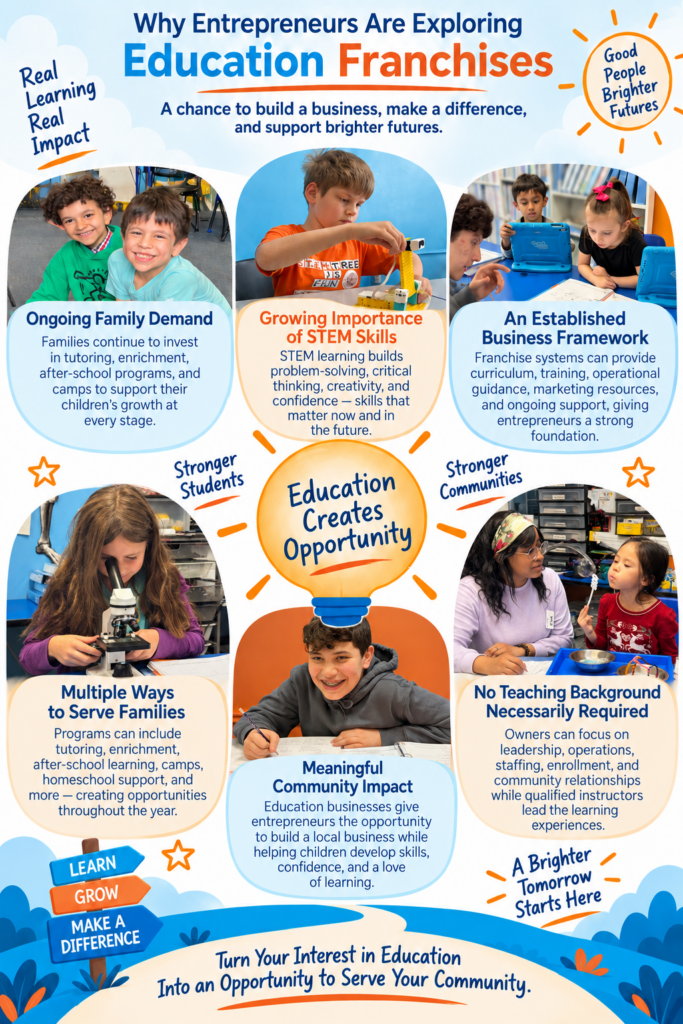
Education remains an important priority for families, and learning does not have to end when the school day is over. Many parents seek additional opportunities that can help their children reinforce academic concepts, build confidence, explore new subjects, and develop skills in an engaging environment.This creates an ongoing need for services such as tutoring, after-school enrichment, camps, and specialized educational programs. Supplemental education can also serve students with different goals. Some children may need additional support with concepts they find challenging, while others may be ready to explore subjects beyond what they encounter in their regular classrooms.For entrepreneurs, this means an education business can address a meaningful need within the community while serving families at different stages of their children's learning journeys.
STEM Skills Are Increasingly Important
STEM (Science, technology, engineering, and mathematics) skills are an important part of preparing students for a world increasingly shaped by technology and innovation. For parents, however, STEM education is not simply about encouraging a child to pursue a particular career. Strong STEM experiences can also help children practice critical thinking, logical reasoning, experimentation, creativity, and problem-solving.Hands-on learning can make these subjects more approachable by giving students opportunities to apply what they are learning. Instead of only reading about a concept, children can build, test, code, observe results, solve problems, and adjust based on what they discover.For entrepreneurs exploring education franchises, this emphasis on practical learning is significant. The long-term strength of an education business is closely connected to the quality and relevance of the experience it provides to students and families.
Franchising Provides an Established Framework
Starting an independent education business requires an entrepreneur to develop many components from the beginning. Curriculum, operating procedures, branding, marketing materials, enrollment processes, staff training, technology, and instructional standards may all need to be created or sourced before the business can operate effectively.A franchise offers a different starting point by providing an established business framework. Depending on the system, franchise owners may receive curriculum resources, operational guidance, training, marketing support, technology, and ongoing assistance. These resources do not remove the responsibilities or risks associated with business ownership, but they can provide greater structure for entrepreneurs entering a specialized industry.This is one reason prospective owners may choose to explore achildren's education franchise before deciding whether a particular concept aligns with their goals, experience, and local market.
Education Franchises Can Serve Multiple Family Needs
Education businesses can often serve families in more than one way. Depending on the concept, programs may include tutoring, enrichment, after-school learning, camps, homeschool support, community partnerships, and other educational experiences designed around different student needs.A varied program structure can also create opportunities to connect with families during different parts of the year. During the school year, parents may seek tutoring or after-school enrichment, while school breaks can create interest in camps and specialized programs. Other families may want consistent STEM or academic learning opportunities throughout the year.For entrepreneurs, having multiple ways to serve students can create a business model that is closely connected to the ongoing needs of local families rather than relying on a single type of educational service.
Education Businesses Can Create Meaningful Community Impact
Education businesses have the opportunity to provide a service that can directly influence how children experience learning. A student who begins to understand a difficult math concept may become more confident in the classroom, while a child experimenting with robotics or coding may discover an interest they want to continue developing.These moments can be meaningful for students and their families, but they also help explain why entrepreneurs are drawn to the education sector. Building a sustainable local business can go hand in hand with creating an environment where children are encouraged to ask questions, solve problems, explore ideas, and develop useful skills.For entrepreneurs who want their work to have a visible connection to their community, an education franchise can provide a way to combine business ownership with a mission centered on student development.
Owners Do Not Necessarily Need to Be Teachers
A common misconception about education franchises is that every owner must have a professional teaching background. Requirements vary among franchise systems, but ownership and classroom instruction can involve different responsibilities, allowing franchise owners to focus on areas such as leadership, operations, staffing, community relationships, enrollment, and business development.This distinction can make education franchising accessible to professionals from a range of backgrounds. Experience in management, technology, sales, marketing, finance, or other fields may provide useful skills for running a local business, while trained instructors and established curriculum can support the educational side of the operation.What matters is understanding the franchise's requirements, being prepared to lead the business effectively, and sharing a commitment to providing a strong educational experience for children.
Strong Educational Experiences Can Build Lasting Family Relationships
Trust is especially important in an education business because parents are choosing an environment where their children will spend time learning and developing new skills. Families want to know that students will be supported, appropriately challenged, and encouraged to make progress at a pace that recognizes their individual strengths and needs.Personalized learning, hands-on activities, knowledgeable instructors, thoughtful communication, and relevant programming can all contribute to that trust. When parents see their children becoming more engaged, confident, or curious about learning, an educational center has an opportunity to become a valued part of the family's routine.For franchise owners, this relationship-driven aspect of education can be particularly important. Building a strong local reputation often begins with consistently delivering an experience that students enjoy and parents value.
Education Franchising Combines Entrepreneurship With Purpose
People pursue entrepreneurship for many reasons, including professional independence, financial goals, personal growth, and the desire to build something of their own. Education franchises add another dimension by connecting those entrepreneurial goals with services designed to support children and families.This combination can be especially appealing to entrepreneurs who want their business to have a clear purpose within the community. At the same time, prospective franchisees should approach any opportunity carefully by reviewing the franchise disclosure document, initial and ongoing costs, territory, operational requirements, training, support, competition, and financial expectations.Understandingwhy education franchises are considered resilient business investments can provide additional context for entrepreneurs evaluating the category. Ultimately, the decision should be based on careful research into both the franchise system and the needs of the local market.
Building a Business Around Better Learning Experiences
The appeal of education franchises goes beyond having an established business model. At the center of the opportunity is something families consistently value: helping children learn, strengthen their skills, discover new interests, and become more confident in their abilities.Stemtree Education Center's franchise opportunity is built around personalized, hands-on STEM education for students in grades K-12. Programs in science, coding, robotics, electricity and electronics, and mathematics are designed to help students learn through exploration and application, while franchise owners receive training and ongoing operational, marketing, and curriculum support.For entrepreneurs interested in building a business around meaningful educational experiences for children and families, explore the Stemtree franchise opportunity and request franchise information today.
Key Takeaways
Education franchises can address family demand for tutoring, enrichment, after-school learning, camps, and specialized educational experiences.
STEM learning can help children develop problem-solving, critical thinking, creativity, and technical skills.
A franchise can provide established systems, curriculum, training, and ongoing support for entrepreneurs entering the education industry.
Multiple programs can help an education business serve different family needs throughout the year.
Franchise ownership does not necessarily require a professional teaching background, although requirements vary by system.
Strong educational experiences can help franchise owners build trust and lasting relationships with local families.
Prospective owners should carefully evaluate costs, support, operations, territory, and local market needs before investing.


Sorry, the comment form is closed at this time.